
In May 2021, Google will update their core web vitals metrics, which measure website performance from a user point of view. Specifically, the three core web vitals will measure how fast a page’s largest image or text block loads (Largest Contentful Paint), how fast a page becomes visible to the user (First Input Delay), and how stable a page looks to the user (Cumulative Layout Shift). The metrics will impact how a website is ranked in a Google search. It’s a good idea to learn about them and talk with your web designer to see if and how your website needs to change. In the meantime, here is a summary of the three most impactful measurements:
Largest Contentful Paint: This measures how long it takes to load the largest block of information on your landing page. The new metric says this should happen within 2.5 seconds of when the page first starts loading. Steps can be taken to reduce load times, and sometimes the solution is to save the largest images for another page.
First Input Delay: Users should see your page immediately after hitting Enter or tapping on a link. Delays are frustrating and can make users question the site’s credibility. The new metric says sites should shoot for a First Input Delay of 100 milliseconds or less.
Cumulative Layout Shift: Users prefer webpage content to be stable. When you start to read an article on a webpage and all of a sudden the text shifts, or worse, if you go to click on a link and an ad appears where the link was, now you’re on the ad’s website. You know the frustration of cumulative layout shift. To provide a good user experience, pages should maintain a CLS of less than 0.1. A good web designer can improve this by reserving spaces for images and embedded resources to load into, which will avoid the shifts.
What Causes User Page Experience Delays?
Many delays are caused by code bloat and the use of plug-ins. When a designer uses templates to build a website, they use code blocks to build attributes of the site. Often the code blocks contain code that isn’t needed for that site, but it’s there and can cause delays in loading. Using plug-ins that contain unneeded code for your site can also cause delays. Plug-ins are common in popular website building platforms.
How Will my Website Measure Up?
A study by Searchmetrics Inc. shows that fewer than 4% of all U.S. websites passed the Core Web Vitals metrics.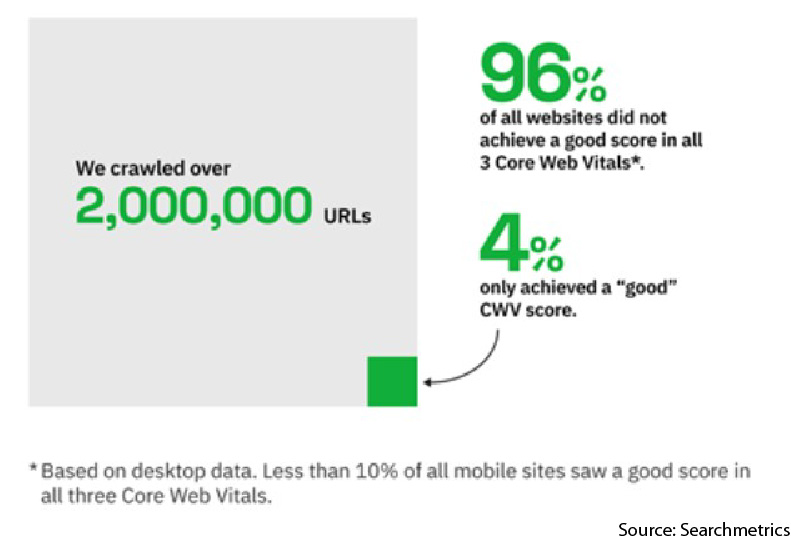
Website owners shouldn’t be too surprised, therefore, if they find their website metrics don’t fall within the “good” range. Notice below that even the top 5 don’t even fare that well, let alone the top 20.
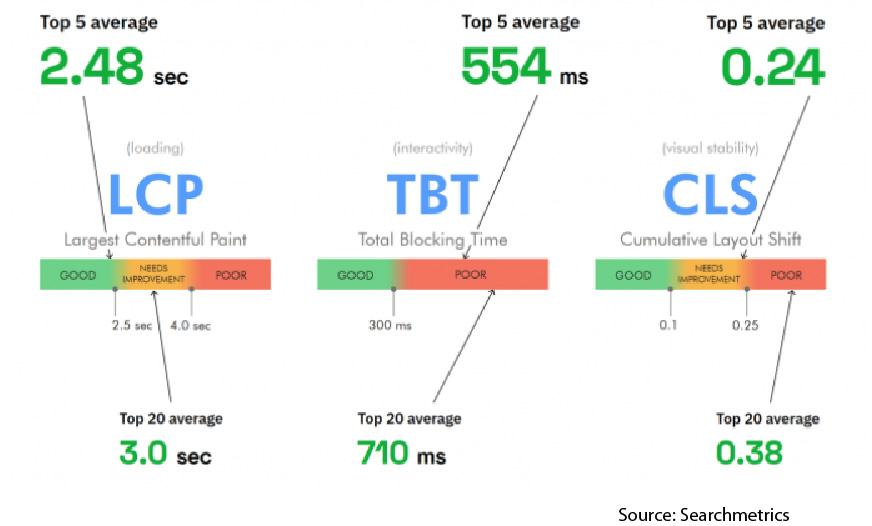
It’s unclear how much the new metrics will affect a website’s ranking, at least initially. Even if there is little immediate negative effect, you may want to work with your web designer on ways to improve these metrics, for two reasons. Improving user experience on your site will mean happier visitors who stay on your site longer. And, if Google uses these metrics to improve your ranking, users looking for businesses like yours will find you easier.
Contact us to learn how we can help you have a website that runs flawlessly.
Leave A Comment