
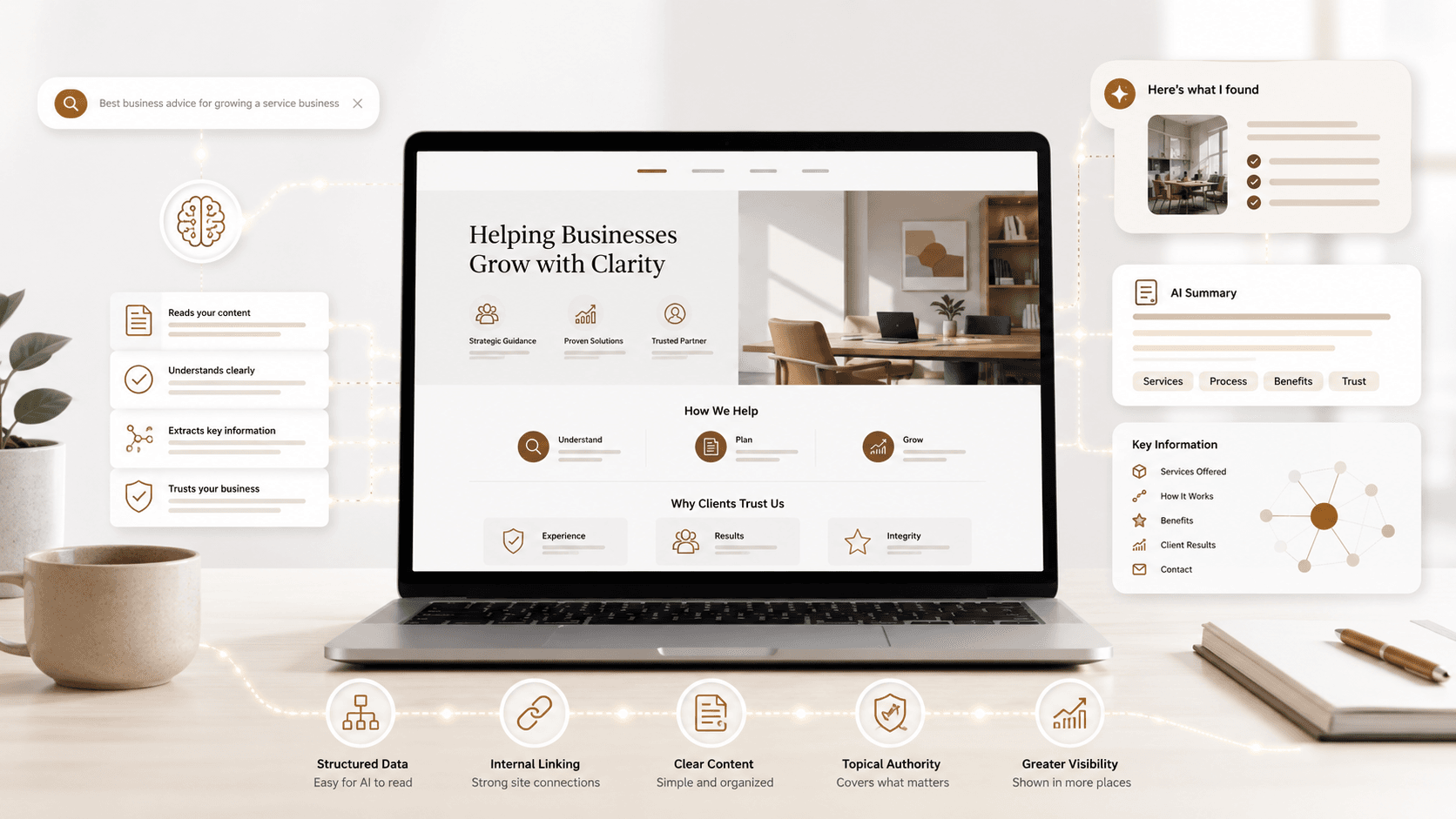
 If you have spent any time searching for something lately, you have probably noticed the change. You type a question into Google and, before you ever see a list of websites, you get a written answer right at the top. Ask ChatGPT or a similar tool the same question, and it just tells you what it thinks the answer is, often without sending you anywhere at all.
For a small business owner, this raises a fair question: if the search tools are answering questions directly, how does my website still get found?
The good news is that the answer is more reassuring than the hype around “AI” might suggest. These systems are not magic, and they are not impossible to plan for. They pull their answers from web pages, and they tend to favor pages that are clear, specific, and genuinely useful. In other words, the businesses winning visibility in this new environment are not the ones with the cleverest tricks. They are the ones that explain themselves well.
Here is what that actually means, and what is worth checking on your own site.
How AI search decides what to trust
Older search optimization was often a game of keywords: repeat the right phrases enough times and hope to climb the rankings. That approach has been losing ground for years, and AI-driven search has more or less finished it off.
AI systems work differently. When someone asks a question, the system reads through pages it considers credible and tries to assemble a clear answer. To do that well, it needs pages it can actually understand. A page that clearly states what a business does, who it serves, and what a customer can expect is easy to summarize and easy to cite. A vague page padded with buzzwords is not, so it gets passed over.
The practical takeaway is simple. The pages that win are structured, specific, and useful enough that a machine can confidently summarize them. Thin pages stuffed with keywords are weak inputs. If a real human would struggle to figure out exactly what you do from a given page, an AI system will struggle too, and it will reach for a competitor’s clearer page instead.
The shift worth understanding
There is a helpful way to think about this. Search engines and AI tools increasingly treat your business as a real-world entity, an actual organization with a track record, rather than just a website with some pages on it.
That means your job is less about gaming a ranking and more about being legible: making it obvious and consistent who you are, what you offer, and why you can be trusted. When the signals all line up and tell the same clear story, these systems are far more likely to surface you as a credible answer.
None of this requires a marketing degree or a five-figure budget. Most of it is housekeeping that you have probably been meaning to do anyway.
What to fix on your site now
Here is a practical checklist. You do not need to do all of it at once. Even working through one or two of these will move you in the right direction.
1. Make your service pages explicit
Every core service should have its own page that spells out exactly what is included, who it is for, and what the customer ends up with. Avoid the temptation to be clever or vague. “We craft bespoke digital experiences” tells a search system almost nothing. “We build and maintain WordPress websites for small businesses that sell nationally” tells it exactly what you do and who you serve.
State the outcomes and deliverables in plain language. If a stranger could read the page and accurately describe your service back to you, you are in good shape.
2. Answer the real questions people ask before they buy
Think about the questions customers actually ask you in those first conversations. How long does a project take? What does it cost, roughly? What happens if something breaks later? What do I need to provide?
Each of those questions can become a short, clear article or an FAQ entry. Pages that answer real pre-sales questions in plain language are exactly what AI systems pull from, because they match the way people actually ask things. As a bonus, answering these questions in writing tends to shorten your sales conversations, because prospects show up already informed.
3. Link your related pages together
When your article about website speed mentions maintenance, link it to your maintenance service page. When your service page references a project you completed, link to that case study. This internal linking helps both readers and search systems understand how your content fits together and reinforces that you have real depth on a topic, not just one stray page.
It is a small habit that pays off, and it costs nothing but a few minutes when you publish.
4. Keep the technical basics in order
Crawlability, speed, and mobile performance still matter, arguably more than ever. If a search system cannot load your pages quickly or read them properly, none of the clear writing above will help. A technically sloppy site does not just lose ranking opportunity, it lowers how competent your business looks to a real human visitor too. The two problems go hand in hand.
You do not need to become a developer to stay on top of this. You just need to know it matters and make sure someone is watching it.
5. Make sure your business looks real and consistent
Search and AI systems look for signals that you are a legitimate, established business. The simplest version of this: your business name, address, and phone number should be identical everywhere they appear online. Your website, your Google Business Profile, your social pages, any directory listings. Inconsistencies, even small ones like an old phone number on one page, quietly erode trust with these systems.
It is unglamorous work, but it is the kind of thing that compounds in your favor over time.
6. Add schema so search systems can read your business at a glance
Schema is structured data you add to your website’s code. It does not change how your site looks to visitors, but it tells search engines and AI systems exactly what a given piece of content is. Instead of making a machine guess whether a number on the page is a price, a phone number, or a review rating, schema labels it directly.
The reason this matters more than ever is that AI search runs on understanding, not just reading. The clearer and more labeled your information is, the easier it is for these systems to use it confidently in an answer. There are different types of schema for different facets of your business, and each one helps a search system see a specific part of who you are:
- Organization or LocalBusiness schema identifies the basics about your company: name, address, phone, hours, logo, and the areas you serve. This is the foundation that tells search systems you are a real, identifiable business.
- Service or Product schema describes what you actually sell, including names, descriptions, and pricing where appropriate.
- FAQ schema marks up the question-and-answer sections on your pages so they can be surfaced directly in search results and AI answers.
- Review and AggregateRating schema lets your customer ratings appear in search listings, adding visible credibility.
- Article or BlogPosting schema identifies your blog content, its author, and when it was published, which helps with both freshness signals and authorship credit.
- BreadcrumbList schema shows how a page fits in your site’s structure, helping search systems understand context.
You do not need to memorize any of this. Most modern WordPress setups can handle schema automatically through a well-built theme or a reputable SEO plugin. The important thing is knowing it exists, knowing it is worth having, and making sure whoever maintains your site is using it deliberately rather than leaving it to chance.
Think of schema as the difference between handing someone a page of unlabeled facts and handing them the same page with everything clearly tagged. Both contain the same information, but only one is easy to use.
How to know it is working
It is easy to get fixated on whether your business gets name-dropped in some AI answer. That is the wrong thing to measure. The more useful question is whether your content is producing more qualified visitors, stronger inquiries, and shorter sales conversations.
If your site is genuinely clearer and more useful, you should feel it in the quality of the leads that come in, not just in a vanity metric. When the website feels more useful to actual buyers, the visibility tends to follow.
The honest bottom line
AI search is a real shift, and it is worth paying attention to. But the response to it is not some exotic new strategy. It is the same fundamentals done well: explain what you do clearly, answer the questions your customers actually have, keep your site fast and consistent, and make it easy for both people and machines to understand who you are.
That is good advice whether or not the search landscape ever changed. The AI era has just raised the reward for getting it right.
If you would like a second set of eyes on whether your site is explaining itself clearly, that is exactly the kind of thing we are happy to look at. No pressure, no jargon, just a straight answer about where you stand.
Talk about quickset tile and grout
It’s promo code in the product